Comparisons · Workspace Tech
Book Scanner vs Document Scanner: Which One Do You Actually Need?
Decide between overhead book scanning and sheet-fed document scanning by originals, page handling, OCR workflow and software constraints.
Published
THE CLEAR TAKEAWAY
Quick Answer
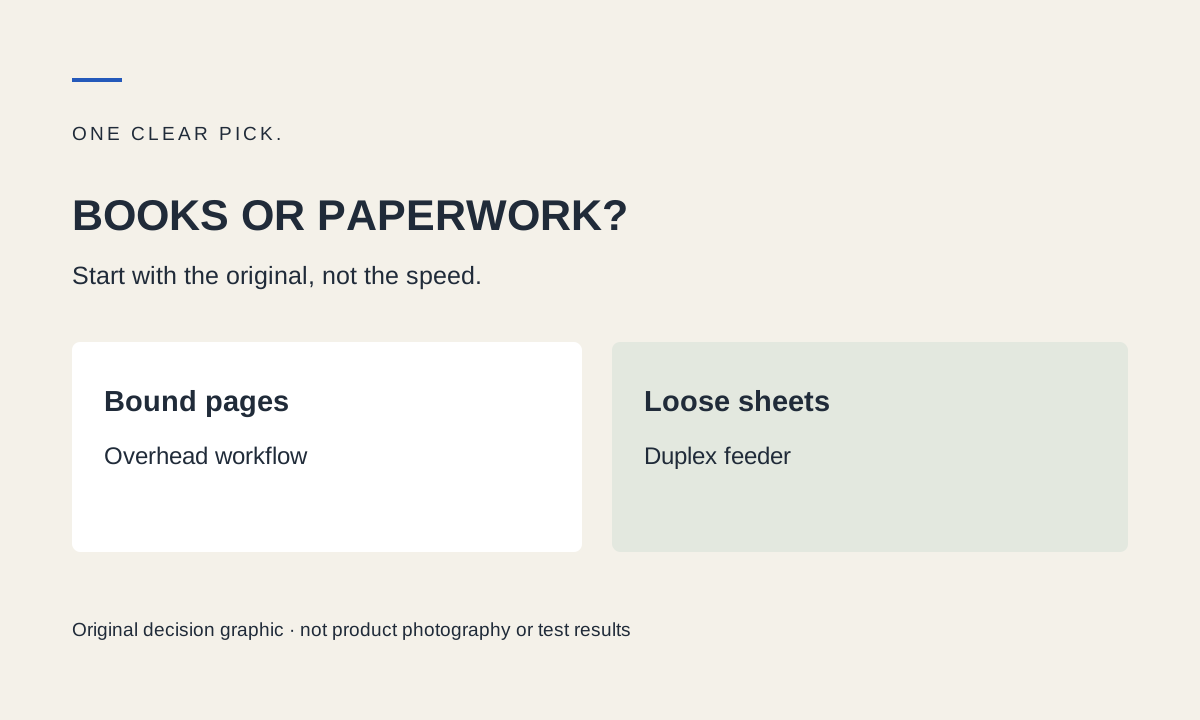
Choose overhead capture for bound pages that must stay bound; choose a duplex ADF scanner for recurring compatible loose-paper batches. Decide by your originals before comparing speed.
Research Method / Evidence Basis
Public-source research. Research-based article. Official manufacturer documentation checked October 26, 2026. We have not used or tested these products. Specifications are manufacturer claims, not independent measurements. Recommendations are editorial inferences about workflow fit.
Editorial responsibility: One Clear Pick · How we research and recommend
This article contains ordinary source/manufacturer links, with no affiliate purchase links. How commissions work.
| Your main task | Start with | Acceptance check |
|---|---|---|
| Keep books bound | Overhead capture | Book thickness, glare and manual page handling |
| Process loose two-sided paperwork | Duplex ADF | Supported paper and software; both sides retained |
| Occasional fragile or awkward originals | Non-feeder workflow | Permitted handling; avoid forcing materials flat |
| Create searchable files | Either, with supported OCR | Inspect recognition and file organization |
The 30-second answer
A book scanner keeps the binding intact while a sheet-fed document scanner moves separate pages through rollers. The words “document scanner” also cover several designs, so check the handling method rather than relying on the product category. A scanner that solves one job well can be inconvenient for the other.
For a home office with both tasks, identify which happens every week. Buy around that recurring workload and use a separate occasional workflow for the exception. You do not need two new machines simply because your desk contains both books and paperwork.
Keep the book intact: overhead capture
An overhead design leaves the original on the desk while you position it and turn pages. That is relevant to bound notes, reference books and originals that should not enter a feeder. It does not make capture unattended. You still inspect page edges, shadows, curvature, cropping and output order.
Our existing CZUR shortlist is constrained by material fit. Shine Ultra and Aura Pro have different lighting and documented thickness guidance. Neither is an automatic page-turner. A camera’s megapixel count cannot establish OCR accuracy, and a flattening feature does not guarantee faithful reproduction of a curved page.
Before choosing, measure a typical open original and consult the exact model documentation. If your materials exceed the stated guidance, do not solve the mismatch by assuming software will repair everything. The book-scanner shortlist sets out exclusions.
Clear a paper backlog: duplex ADF
An automatic document feeder addresses a different constraint: repeatedly loading and moving compatible loose pages. Duplex capture is valuable when information is on both sides. Sorting, staple removal, checking and filing remain part of the work.
The existing ScanSnap iX2500 candidate offers a large feeder but no TWAIN driver. That driver limit can exclude it even when the hardware looks suitable. A feeder recommendation must fit both the originals and the application. For the full model shortlist, use our document scanner guide.
Why “one second” and “45 ppm” do not settle the choice
An overhead capture-time claim leaves out turning and positioning pages. A feeder speed rating leaves out preparing the stack, recognizing text and saving checked files. The units describe different stages under manufacturer conditions. We have not timed either complete workflow.
Instead, describe a representative job: the number and condition of originals, whether both sides matter, the required output, and where the file must end up. Compare the steps that need your attention. That is more useful than converting unlike marketing figures into a supposed winner.
Use cases and reasons to skip
Choose overhead when preserving a binding is essential and you can handle pages individually. Skip it as the primary solution for a recurring stack of loose duplex invoices. Choose an ADF for suitable loose-paper batches, but skip it for intact bound books or materials outside the permitted feed specification.
For a single small job, first consider equipment you already own or an appropriate scanning service. We make no archival, legal-retention or productivity guarantee. Preserve originals until you have checked the output and your own retention requirements.
A practical acceptance check
Try representative pages during a permitted return period. Count originals and output pages, inspect both sides, search a known printed phrase and reopen the file on your usual device. Check diagrams and small print visually, rather than treating a searchable PDF as proof that all content survived.
This article explains format choice; it does not repeat the general model ranking. Exact-model purchase trade-offs are in Shine Ultra versus ScanSnap iX2500. No Black Friday price or deal is asserted.
FAQ
Is every document scanner sheet-fed?
No. Document scanner is a broad category; inspect the actual handling method.
Can an ADF preserve an intact book?
No. A bound book must not be fed through a loose-sheet ADF.
Sources and References
- CZUR Shine Ultra specifications
Manufacturer documentation checked October 26, 2026. Supports the specified model facts; not independent performance evidence.
- CZUR Aura Pro specifications
Manufacturer documentation checked October 26, 2026. Supports the specified model facts; not independent performance evidence.
- Ricoh iX2500 US specifications
Manufacturer documentation checked October 26, 2026. Supports the specified model facts; not independent performance evidence.