
Comparisons · Consumer Tech
GiiKER Super Slide vs. Rush Hour: Which Sliding Puzzle Fits?
Compare GiiKER Super Slide and ThinkFun Rush Hour on setup, hints, batteries and travel. Pick the sliding block puzzle that fits how you play.
Published
THE CLEAR TAKEAWAY
Quick Answer
Start with ThinkFun Rush Hour if you want a battery-free introduction to sliding block puzzles. Choose GiiKER Super Slide if you expect repeat solo play and want built-in layouts, step-by-step hints and a timer.
Research Method / Evidence Basis
Public-source research. Research-based comparison of the original black GiiKER Super Slide (JKHRD001, Amazon US B09F67K7T6) and the standard ThinkFun Rush Hour (US item 76582), based on the manufacturers’ specifications and instructions. We did not play either game for this comparison.
Editorial responsibility: One Clear Pick · How we research and recommend
| Decision factor | GiiKER Super Slide | ThinkFun Rush Hour |
|---|---|---|
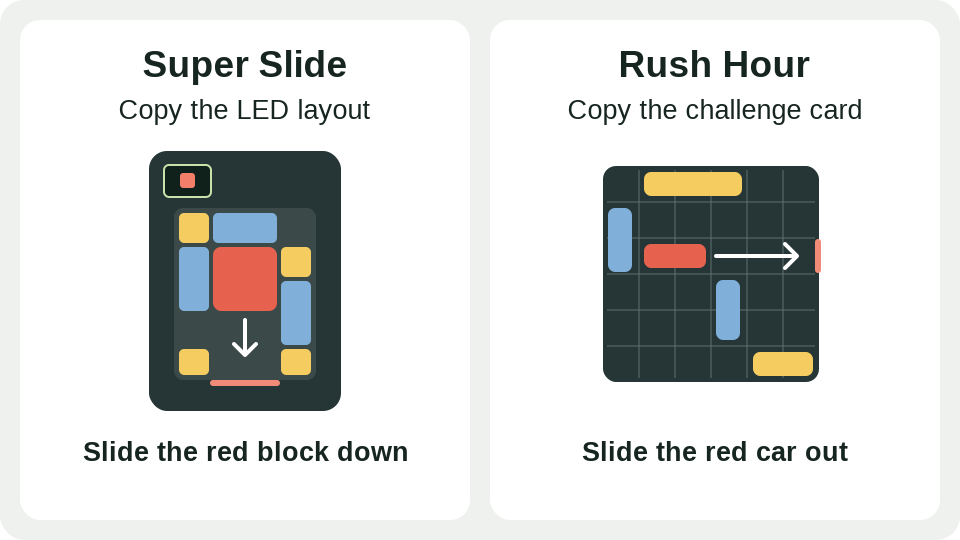
| Setup | Copy a starting layout from the built-in LED display | Place cars and trucks as shown on a printed challenge card |
| Goal | Slide the large red square into the exit zone | Slide the red car out of the grid |
| Challenges | 500+ layouts listed by GiiKER | 40 challenge cards listed by ThinkFun |
| Help | Step-by-step Learn Mode, plus a separate timed Challenge Mode | Printed answers on the challenge cards |
| Power | Two AA batteries, sold separately | No batteries |
| Manufacturer age guidance | 6+ | 8+ |
Both games ask you to clear an exit
The illustration shows where the target piece has to go. In Super Slide, different block shapes compete for space as you move the large red square toward the bottom of the board. In Rush Hour, each car or truck moves along its own axis as you clear a lane for the red car. Both start with a setup step. Choose Rush Hour if arranging a small traffic jam sounds more appealing. Choose Super Slide if you prefer fitting and moving differently shaped blocks.
The upgrade is in the prompts and feedback
Super Slide puts the starting layouts on the display, offers step-by-step help in Learn Mode, and detects when you finish. That combination makes sense for someone who already likes this kind of puzzle and will return to it often. Rush Hour also offers a way to get unstuck through its printed answers, and its cards and board work without power.
The two age labels are the manufacturers’ starting points. For a gift, consider whether the recipient enjoys copying a layout and moving small pieces. If the recipient is new to sliding puzzles, those two steps matter more than the number of challenges on the box.
What to pack for a trip
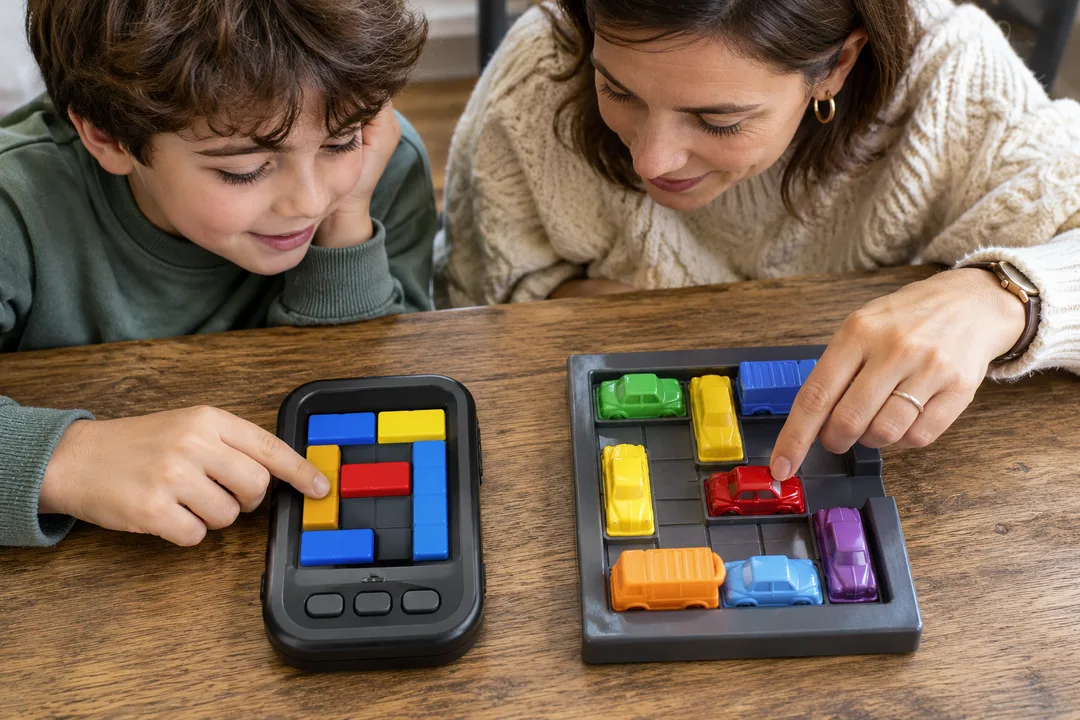
For an airplane tray or a hotel table, Super Slide’s built-in layouts mean there are no cards to keep in order. Pack two AA batteries and a pouch for loose pieces. For Rush Hour, bring the pieces and a few challenge cards. If play will mainly happen in a moving car or during short stops, consider a puzzle with captive pieces that can be put away quickly.
If the built-in hints and larger library are what you’re shopping for, see our original black GiiKER Super Slide review for the exact U.S. listing, the product photo and what to check before buying.
FAQ
Can you play GiiKER Super Slide without a phone?
Yes. The built-in LED display provides the starting layouts and the board detects the red block at the exit. It needs two AA batteries.
Which puzzle works better for travel?
Super Slide puts the layouts on the device, while Rush Hour avoids batteries. Both use removable pieces. Choose a puzzle with captive pieces if you expect to stop mid-game or lack a stable setup surface.
Is GiiKER Super Slide a harder version of Rush Hour?
Both offer progressively harder layouts, but they use different pieces and board arrangements. The published challenge counts tell you how many layouts are provided, and we have no head-to-head play data for their difficulty.
Sources and References
- GiiKER Super Slide product specifications
Age guidance, battery requirement, play modes, challenge count and completion sensor.
- ThinkFun Rush Hour, US item 76582
Standard US edition, 40 challenges, printed answers and age guidance.